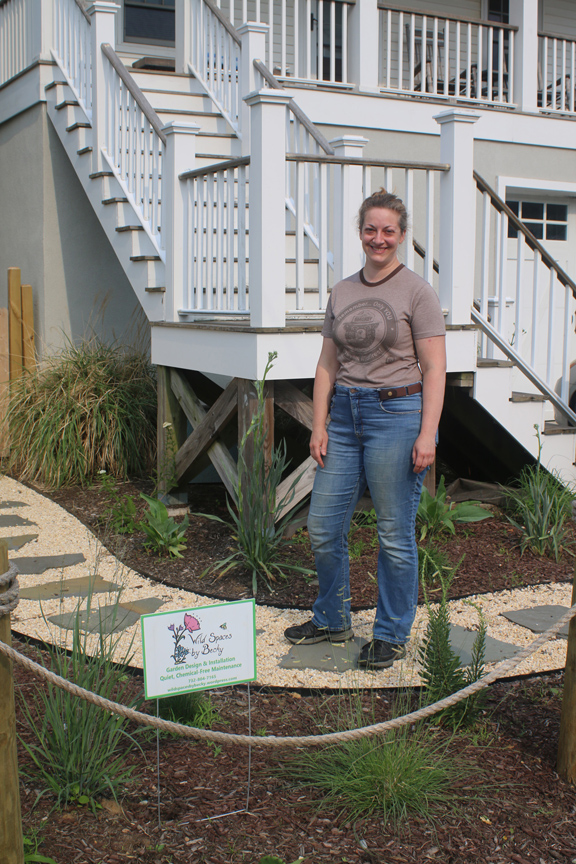
Becky here, thanks for your interest in being part of shaping our environment for the better! And for your interest in how and why Wild Spaces by Becky began!
In 2018 I had the idea to start my own business creating habitat gardens. I wanted to do work that matters to me and nature has always been an important part of my life and I want to be a part of preserving it.
As a kid, I loved spending quiet, contemplative hours by myself in my backyard, laying in the grass and becoming a part of the little universe of beetles and ants, crickets and caterpillars, going about their day. I would put a finger out for them to crawl across my skin, feeling the delicate rhythm of legs, the gentle tapping of antennae. I loved that I had my own jungle to explore, my own zoo, my own botanical garden. I didn’t need anything but open eyes and a gentle step to go into these worlds and be excited by new things every day. And I was excited! Every new bug I saw was one I personally discovered. Every plant was a bloom hiding in secret corners for only my eyes to see. These pieces of nature revealed themselves because my parents allowed them to by mostly leaving our yard be.
In my mid-twenties, after perusing different career choices, I remembered that nature has always been at the core of my curiosity, excitement and joy. With revitalized passion, I began a new course of education studying environmental science, ecology, and biology. I learned practical skills lending my friend a hand at the community garden she ran. I found an opportunity to volunteer for the state park service and asked for whatever project was being most neglected. I monitored the Osprey and created comprehensive data sheets, which led to a job offer.
Working for the park service was the best job I had, until Wild Spaces. I created new projects, wrote education materials, memorized the terrain of the entire park, planted trees in the swamp, and learned invaluable information from my experiences and from my boss. I learned that state parks are not the untouched preserves of nature I assumed they were. Because of red tape, we couldn’t keep wildflower meadows where lawn was more lucrative; we couldn’t keep gas blowers and pesticide sprayers from operating; we couldn’t keep areas unmaintained and didn’t have the budget to reintroduce greater amounts of native plants. This greatly influenced my later revelation that if I wanted to make a difference, it would have to be where there was no red tape- people’s own backyards.
From there, I took a summer job out in Michigan with a conservation society to restore the dunes on Lake Michigan by removing invasive baby’s breath. I had to obtain a pesticide applicator’s license for the job, and at the time I was ignorant of any information about pesticides and the harm they cause, but began to realize the negative effects while studying for the license. The study materials are filled with all the reasons you shouldn’t use them. That, along with the reactions of the people who lived in the small town when they saw us spraying, got me to question what we were doing. During that job I saw an entire day’s worth of glyphosate (40+ gallons) not work, I witnessed my colleagues spray the endangered thistle because they were careless, and I learned that my bosses didn’t have an answer to my question about the effects these chemicals would have on the organisms in the lake. When I returned to NJ and got back to my classes, I learned a lot more about the harmful chemicals in our environment.
With all of this knowledge, I still found myself having to take a job with a local weed control company. Although it was difficult to do the work, knowing what I did, this too was an invaluable learning opportunity. I learned that applicators are incentivized to spray greater amounts even when conditions say they shouldn’t; I learned that applicators are told to spray plants the chemicals won’t work on to placate customers; I learned that applicators are told to spew a stream of scientific sounding words to confuse customers into silent acceptance when they have valid questions; I learned that applicators are not provided with nor offered protective gear and are outright advised against it because it “looks bad”; and I learned that there are customers who are concerned with the safety of the chemicals but don’t know there are alternatives or don’t realize how harmful these chemicals really are. I wouldn’t play along. I took losses on hours, sales commissions, and bonuses by sticking to what is right; not spraying during wind or rain or during temperature inversions; telling customers the truth when they asked if the products were organic or if they were safe for their immunocompromised children and pets; showing up to houses wearing full protective gear making customers question the safety of the products; and by spraying the least amount of liquid possible.
While walking through people’s yards I began to notice the wonderful variety of beautiful “weeds”. I started taking pictures of all of them to research at home and began posting the info I learned on my Instagram, calling the series “Weed It? Or Need It!” Many plants were beneficial, edible, non-invasive, or native. So why not leave them be? The final push for me to take all I had learned and do something to make a difference was one vacant lot I had to spray. I had been consciously avoiding spraying milkweed and plants where I saw insects present in customers yards, but this job there would be no avoiding that. The lot had transformed through neglect into a beautiful wildflower meadow. Beautiful colors, textures, butterflies, bees, and stands of milkweed, and it made me ill to be the hand that had to destroy it.
Finally the beginnings of Wild Spaces began to take shape. I could go back to why I love nature so much and try to help people discover a wonder of nature and work with them to create that jungle zoo botanical insect garden in their own backyards.
