Native Gardens Designed to Impress
I’ve heard people talk about the bad reputation native gardens have for looking messy. I think a messy look comes from a few misguided efforts. One is letting your yard go wild with no editing, and the other is trying to make every native garden into a meadow.
The meadow is what I see highlighted the most in encouraging plantings that benefit wildlife, but here in NJ, the meadow is not an ecosystem that exists. The misnomer of the Meadowlands may lead you to think we should have meadows, but the closest we have is wetlands that have predominately grassy vegetation that resemble a meadow. So trying to mimic a meadow, sets you up to have issues.
A native garden can also end up looking unkempt when the planting is too monotonous. My 5 Keys to a Great Design will show you simple methods to make your garden look like a professional design.
5 Keys to a Great Design
1.Start with the Right Plant Community
Why is using a natural plant community to inform your plant selection important? Because plants in a community have evolved to grow together, share resources, and occupy different above- and below- ground space.
I will have these plant community lists in the book that cover the variety of habitats that occur in New Jersey. They will be edited down to include the most foolproof plants that will reproduce quickly, and are easy to find.
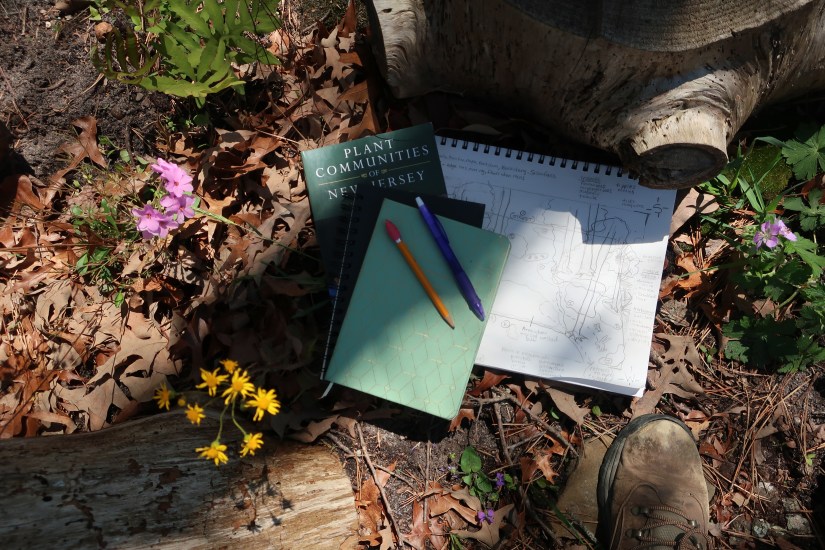
Maybe you think the natural plant communities that grow near you are all boring. I’ve thought that when I moved to the Pine Barrens and first started to research what I could grow in my dry sandy soil. At a cursory glance of the natural areas around me, I didn’t see a lot of color and texture. But oh was I wrong! Check out my picture below of my sample swatch made up of a community of piney plants that is referenced in the research texts I’ve read, and also viewed in person at my local park!
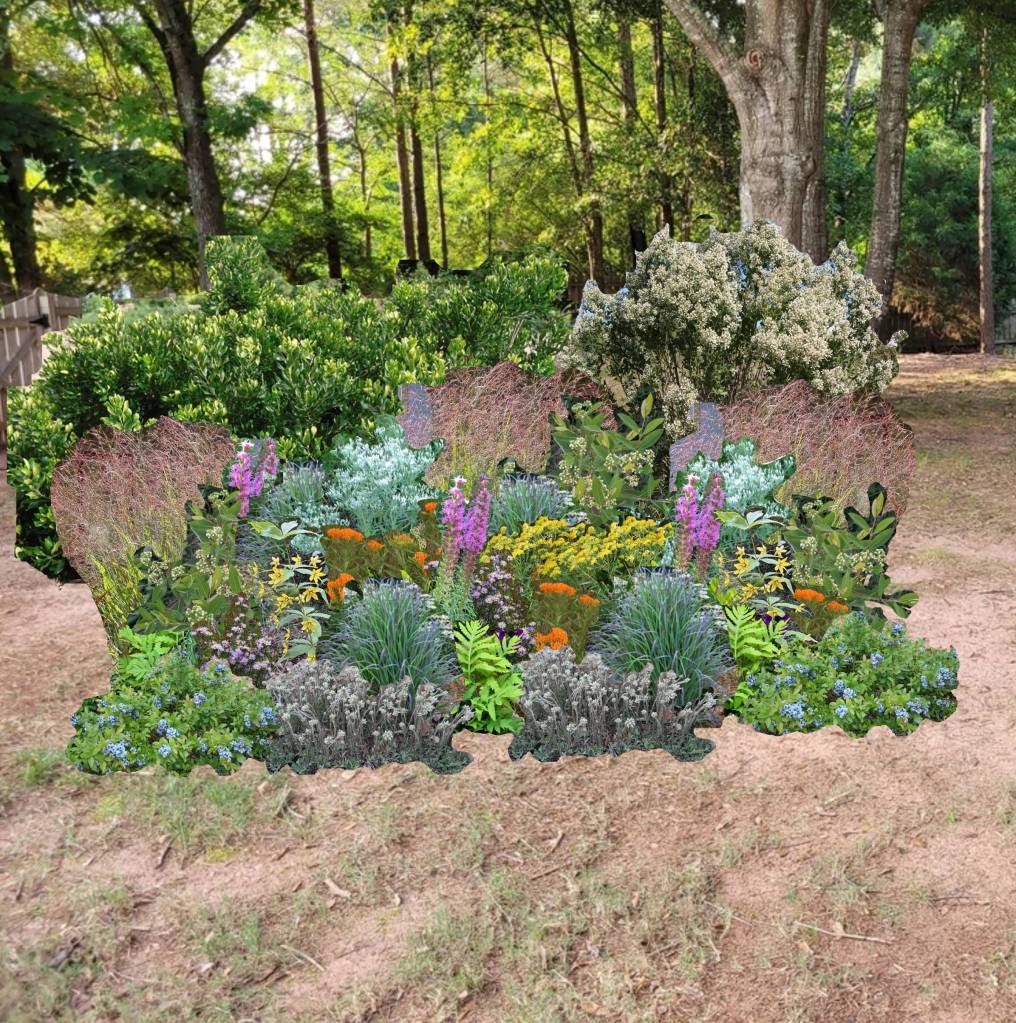
In nature colorful blooms are more punctuation among a bed of various foliage, but cluster them in the garden and you’ve got more visual impact!
2. Include each Structural Layer
I break down the layers into Architectural, Ground Cover, and Seasonal.
-The architectural layer will be the anchor points of the garden. It will be plants that stand all year- trees, shrubs, and grasses- that have the visual weight to show your new garden is an intentional planted design.
-The ground cover layer fills in the gaps between the other plants which keeps roots moist and cool, shades out weeds, and will ultimately eliminate your need for mulching.
– The seasonal layer is made up of plants that die back to the ground each winter and reemerge at different times during spring, summer and fall. These plants will be chosen based on foliage rather than flowers. You will be seeing the foliage for most of the year and the flowers for only short windows of time, so you don’t want to choose based solely on flower colors that you like. Do however, try to have something flowering for each of the 3 seasons to help feed pollinators, which can include your trees, shrubs and ground cover.
3. Contrast Textures, Density, and Heights
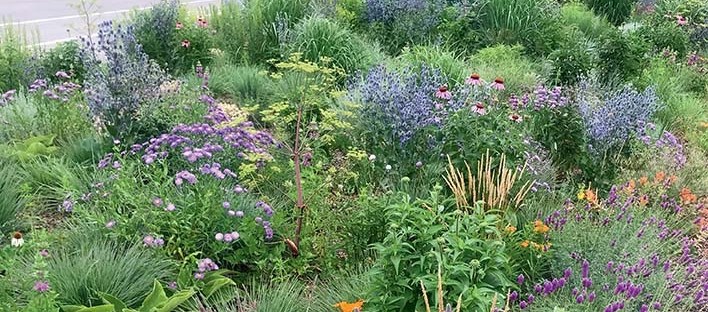
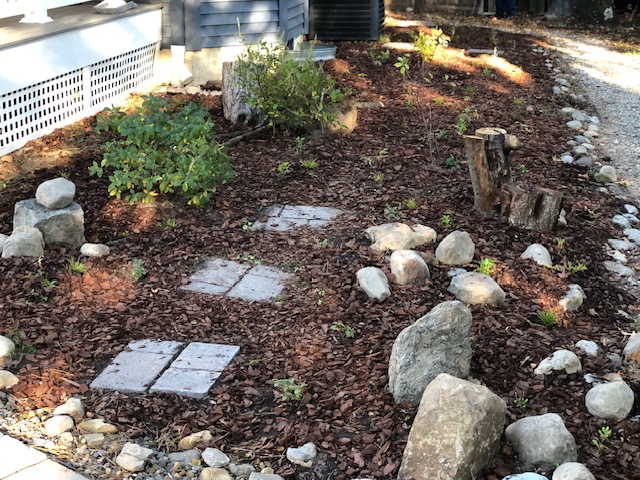
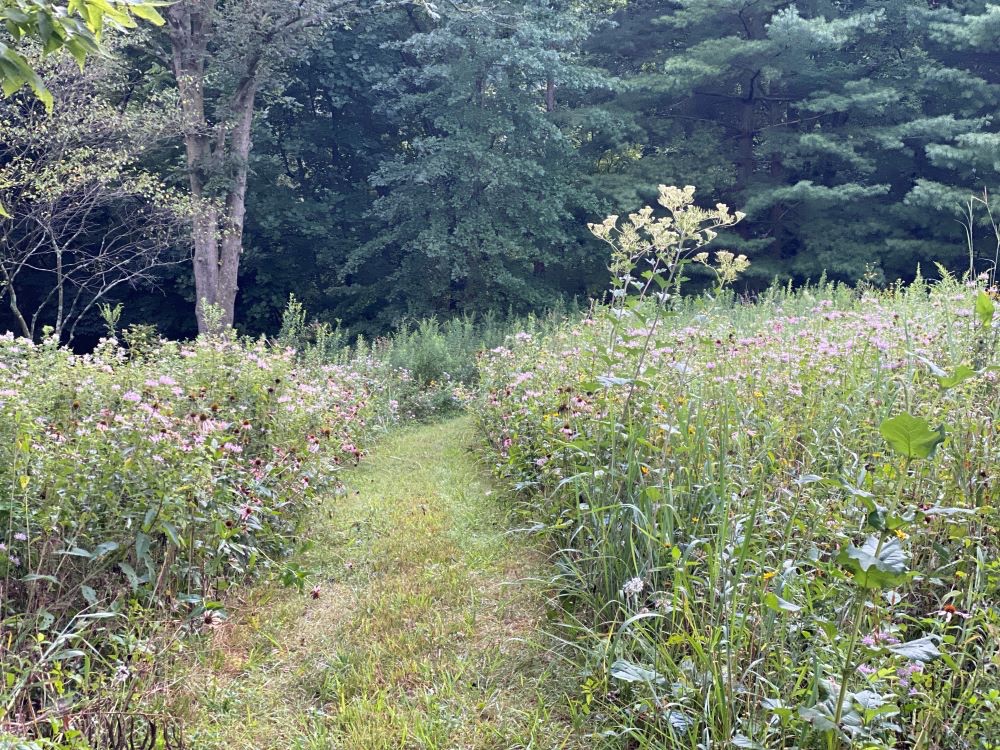
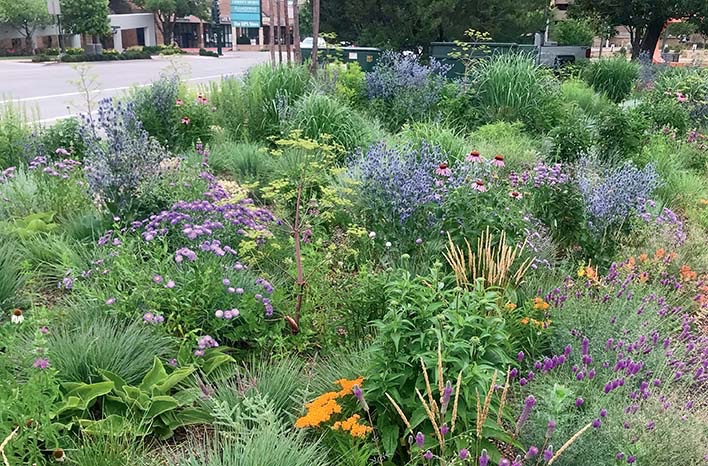
To keep your planting from looking like a monotonous swath, mix it up. Contrast fine textured leaves with bold leaves. Pair visually airy plants with visually heavy plants Mix taller and shorter plants so there is visual breathing room when viewing your garden. Compare the pictures below.
4. Limit Variety
It’s tempting to use as many different plants as possible in your garden for biodiversity, but too much variety can be visually overwhelming. It is better to choose fewer plants and repeat them through the planting to create continuity across the garden. You can even repeat the same textures and colors and not the exact same plant to create the visual flow.
5. Visual Flow
I treat each garden space as an individual vignette, its own framed piece of art. Look at the space from the perspective it will be viewed from and decide where your focal points will be. In creating a landscape painting, you want the eye to travel a pathway across the piece, from one focal point to the next and back to the beginning again. I do this by spreading out 3 focal points in an uneven triangle. Focal points can be architectural plants, artfully laid logs and rocks, or garden décor. Then you will use your repeated plant colors and textures in the same way, grouped around your focal points.
Using these techniques will ensure a visually interesting and pleasing garden design. More detailed information will be available in the book!